Stockade History
This article by J. B. Rettew gives a brief history of the original Camp Horseshoe stockade sites. It first appeared in the July 2001 issue of the The Octoraro Loop.
Editor’s Notes June 2001
I was walking out of Allen Memorial Dining Hall with Moose Winsch after taking pictures for this issue of The Loop. We were discussing some of the articles in the Loop he liked and he brought up the question as to whether campers today knew any of the history behind the naming of the original five Stockade camps. He thought this might be of interest to some of our younger alumni/ae.
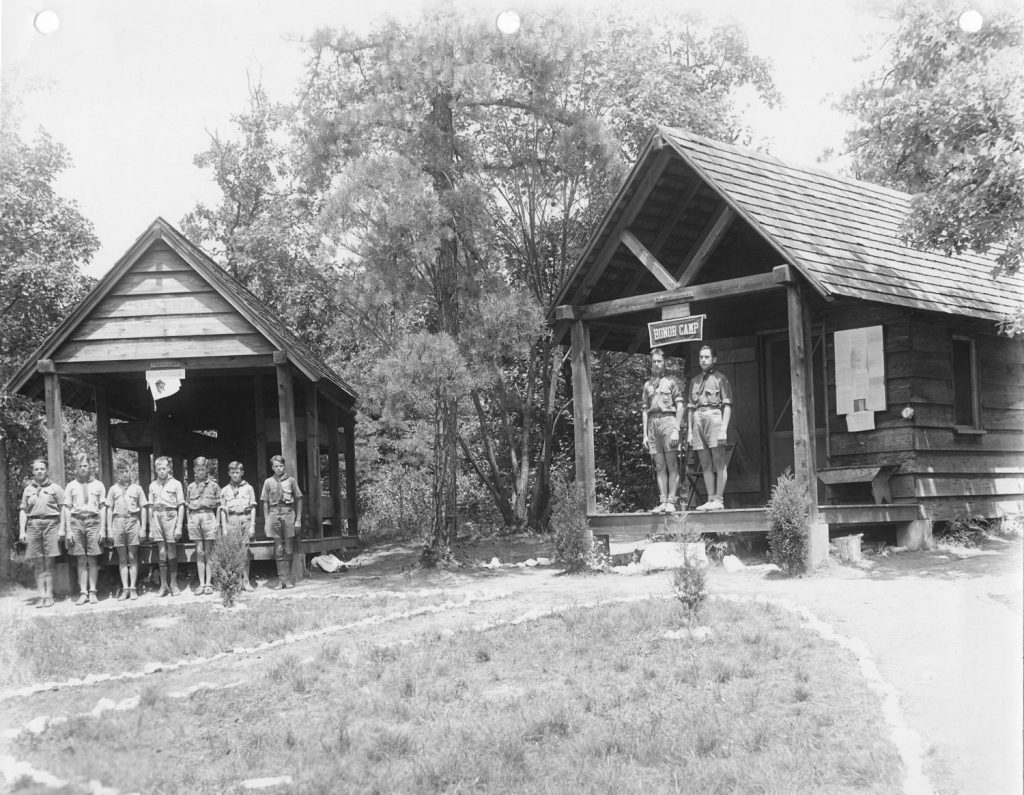
Ernie Heegard’s column mentions the five Stockades. He was in Kit Carson Stockade his first year. I was in Boonesboro in my first year, 1944.
There were five Stockade camps built in 1927-28 for campers that first summer and used ever since then. A visitor to Horseshoe in 1933 wrote of the camps in his treatise, referring to them as “Kit Carson, Boonesboro, Fire Circle, Sherwood Forest and Bayard Taylor“.
Another historian in his writings refers to “Camp Unami, Camp Daniel Boone, Camp Kit Carson, Camp Dave Crockett; and, Old Ironsides Camp (the Sea Scout and Water activities Camp).” Later, the Unami Camp was re-named Sherwood Forest; Daniel Boone became Boonesboro; Old Ironsides became Camp Mason-Dixon (it straddles the Mason-Dixon Line) in 1929 and Pirates camp in 1930. Subsequently, it was renamed Bayard Taylor in honor of the great Chester County writer.
The stockades form a crescent. In earlier days of camp, trails (now the stockade trail) leading to each camp carried a specific name related to the history of the specific camp. Kit Carson was reached by the “Santa Fe” trail; S h e rwood Forest (then Unami) was reached by the “Unami Pa t h ” ; Boonesboro by the “Wilderness Trail”; Dave Crockett was reached by the “Alamo Trail”; and, Old Ironsides by the “Clipper Wake” trail.
In future issues, I hope to shed more light on the other camp units that today make up both Camp Horseshoe and Camp John H. Ware, 3rd. Also, I’ll try to publish the text to the songs that each camp sang after the meal in Allen Memorial in those years from 1928 to the ’50’s.