

Exhibit Details
This exhibit contains various accounts of the history of Horseshoe Scout Reservation published over the years.


OA Horseshoe History
Display Details
In the early 1970’s, the Octoraro Lodge #22 History Committee published this history of Horseshoe Scout Reservation.
“This history was produced under the auspices of the Executive Committee of the Octoraro Lodge #22 Order of the Arrow. This history was written and researched by the Camp History Committee in 1972-73, Chairman, Charles Lawrence; Advisor, Robert McCarter.”
This HTML version of HORSESHOE contains the original text from the 1973 publication. Pictures have been added from the HSRAA VM collection.
HORSESHOE
1973 – Contributed by Robert K. McCarter
Special thanks go to Mr. H. J. Schramm, Mr. C. M. Heistand, Mr. G. E. Heegard, Mrs. W. F. Lawrence and the many others who helped in the production of this book.
This history was produced under the auspices of the Executive Committee of the Octoraro Lodge #22 Order of the Arrow. This history was written and researched by the Camp History Committee in 1972-73, Chairman, Charles Lawrence; Advisor, Robert McCarter.
Below Wood’s bridge the Octoraro meanders around the southwestern corner of the West Nottingham Township and flows into Maryland; then loath to leave the state that gave it its birth it turns northward once again and lingers long enough to murmur its farewell and, having done so, hastens on the quest for the Susquehanna.
Who first gave the name of “Horseshoe” to this portion of the Octoraro or when it was given are alike unknown.

We do know that the Indians were here at Horseshoe. Artifacts have been found to show that the site of well known Buzzards Rock was a former shelter, look-out station and prayer rock for the Leni-Lenape tribe of the Delaware Indians. Below the rock was an Indian village, while directly across the creek was a large grassy plot which was used to pasture their horses. Many articles such as cooking utensils, bones, tomahawks, arrowheads and peace pipes were found under the rock, which would indicate that this was a sacred spot used for burying.
Some authorities think that other Indian tribes beside the Delawares used the Horseshoe loop as a camping ground. They feel that this was the site of the old Shawana Town that was reported to have been in this section of the county. This group of Indians migrated from the south to the southern area of Pennsylvania, but the exact location of their settlements has never been definitely determined. To support their claim they refer to a road proceeding of 1719 stating,
“on ye west side of Jonas Arskins Land at a poplar marked to Six Notches thence East & North by a course of Marked Trees Until it Comes to ye fording Place at Octoraro at ye old Shawana Town. Thence over Octoraro along ye path Side Marked by Six Notches.”
Early American pioneers, marching westward into Lancaster County marveled at the perfect horseshoe formed by the Octoraro creek at a point where the public road from Port Deposit to Lancaster crossed it by a fording. For three and a half miles this beautiful woodland stream took its graceful bend, forming an almost complete circle. No wonder the weary traveler tarried on his way, to admire nature’s handiwork.
On August seventh seventeen-hundred-fifty-one George Churchman took out his well worn instrument in order to survey two small pieces of land, situated in a loop of the Octoraro Creek called the “Horseshoe Ford.” Mr. Churchman found that this land contained approximately, “70 acres and the usual allowance.”
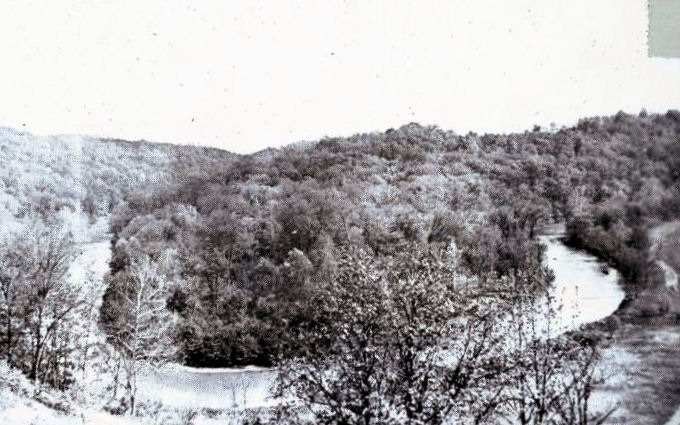
This is the first mention of the name “Horse-shoe” to be found in any record. Evidently it had been informally known by this descriptive name for some time. The name is descriptive because the beautiful Octoraro Creek, in flowing south from Pennsylvania, before reaching the historic Mason-Dixon Line, suddenly turns once again to the North, only to fall into the state of Maryland. However, it does not remain there, turning again to its home, Pennsylvania, for a short distance. Almost immediately it falls once again into Maryland, where it proceeds to its final resting place, the Susquehanna River. In its meanderings, the Creek forms a loop, the narrow end being only three hundred sixty feet wide between the closest portions of the stream.
Mr. Churchman surveyed the land for Robert Mitchel, who apparently did not fully appreciate the potential of the “Horse-shoe Loop,” for he abandoned it. In 1786 John Churchman surveyed the entire tract of land for himself and called it “Crook Hill”. The name “Crook” no doubt came from the rugged terrain, and not from the quality of the inhabitants, for the patent of July 14, 1786, refers to it as “Crooked Hill”.
The land was retained by John Churchman until 1822, at which time it was sold for taxes, the purchaser being on Charles Miner. The consideration named in the deed was four dollars and thirty three cents. Churchman was disappointed in the land, for it is generally believed that he purchased the land for the purpose of mining the minerals which he supposed to be on it. His partner in this venture was Samuel Higes, and together they built a forge below the bend in the stream, in the year 1794. The results were not all that they had expected, so in 1804 the forge was passed into the possession of John Frey and Matthew Irwin. Three years after the purchase, John Frey petitioned that a road be laid out connecting the road leading from Chriswell’s Ferry in Maryland to the Pennsylvania border and the other road from the borough of Lancaster to the “Horse-shoe Fording” on the Octoraro Creek in the best and nearest direction to the Octoraro Forge, the property of the petitioner. For some time after this, although Frey named it the “Octoraro Forge,” it was known to the local inhabitants as “Frey’s Forge.” During the Revolutionary War arms were manufactured at the forge, the fuel coming from charcoal made from wood cut on Goat Hill (now called Flag Pole Hill).
In 1824, the land was again sold, this time to William Work for the sum of two hundred dollars. Two years later the property changed hands again, this time being purchased by Samuel Reynolds. Mr. Reynolds bought the site for three hundred dollars in dried peaches and sheep.

Up until this time, little clearing of the land had been done. Samuel Reynolds set to work to make the area into a farm. With the help of his son, Ira, he began to cut timber and hauled it to the Reynolds’ Pottery below Rock Springs. Also, spar was taken from the mine below the Camp Ranger’s house and hauled by oxen teams to this same pottery.
The first building to appear in the Horseshoe loop was a small flint dwelling, located just below the present site of Kindness Center. This building provided a home for Samuel, his wife and three children. The house was made secure by having the only entrance on the second floor, access to which was attained by climbing a ladder. In the night, this ladder was pulled up into the second floor, and thus the household was safe.
Later in the year 1826, Ira purchased the farm from his father for the sum of one-thousand one hundred dollars. In the cleared area, Ira planted rye, with the timber, he constructed a large double-deck barn, a wagon shed, and a smoke house. Little by little, the beautiful and fertile Horseshoe Farm took shape. The Octoraro, just before finally descending into Maryland, forms a little horseshoe which is known as No-County Bottom. No-County Bottom is the site of the little Horseshoe Creek: formerly it was boundary line of Mason & Dixon and also between Chester County, Pennsylvania and Cecil County, Maryland. The creek changed its course cutting the horseshoe deeper into Chester County. Mr. Reynolds, who owned the Horseshoe Farm, had an argument with Mr. Taylor, who owned the Taylor Property with the result that Reynolds shot Taylor, not seriously, but put him to bed for a while. There ensued a lawsuit, but with no definite conclusion.

Ira turned the property over to his son, B. F. Reynolds, who continued to keep up the fine standards of farming exemplified by his forefathers. His specialty was oxen and sheep. At one time he surveyed the narrows of the hill with the intention of tunneling it for water power. The length of the tunnel would have been three hundred sixty feet. The excavation was begun but was soon abandoned because of the solid rock. The tunnel, which is now little more than a thirty foot cave, can still be seen just below the boating dam.
An interesting fact concerning the waters of the Octoraro is that for many years the Pennsylvania Railroad would use no other water for its engines on the Harrisburg, Philadelphia, New York trains, for they claimed that it was “the purest large stream of water in Pennsylvania.” The waters of the Octoraro have also been used for the transportation of bootleg whiskey. The Horseshoe loop was notorious for the number of stills found on the property. This property was useful for such illegal purposes because of its relative isolation, and also because it was on the Mason-Dixon line and had a good stream of water nearby. The isolation is self explanatory. The convenience of a state line made it possible to pass from one state to another if at any time officials should happen by. The stream made it possible to float the barrels down to the dam where it was removed and distributed to a waiting market.
Many “old-timers” in the Council like to tell of the time when they visited the property before it was purchased by the Chester County Council. After negotiating the rough road into the Horseshoe Farm, they parked near the present site of Kindness Center and walked over to the farmhouse (White House). Unlocking the door, they entered and went upstairs, there to find a number of hats and caps resting quietly on pegs on the wall, but their owners were not to be found.

When one is walking up the beautiful Chapel Trail to Chapel on Sunday morning, it is difficult to imagine that along that very same trail, not too many years ago, bootleggers were being pursued by armed officers of the law. A number of still sites were found over the hill from the present site of the Chapel, back of the old Grey Horse Church. This section was quite remote, especially after services ceased in the church hence it provide an excellent location for distilling liquor.
Besides the road following the stream, which the Council members used to enter the farm, there was another road going through Horseshoe. This read entered by way of Grey Horse Church. From there it came down over Goat Hill (Flag Pole Hill) and joined with the other road at the site of the old barn. The road over the hill was frequented by oxen and carts, for during most of the year this was relatively dry, something which could not be sais for the lower road. Today, this upper road is impassible except by jeep.
The Horseshoe loop was owned by the Reynolds family until 1903, at which time it was sold to the Tyson Mining Company. The land was noted for its mineral deposits, even for its gold. However, the company soon found that it required more money to mine the minerals than the ores were actually worth, so the project was abandoned. In 1928, the property was sold to the Chester County Council, Boy Scouts of America.
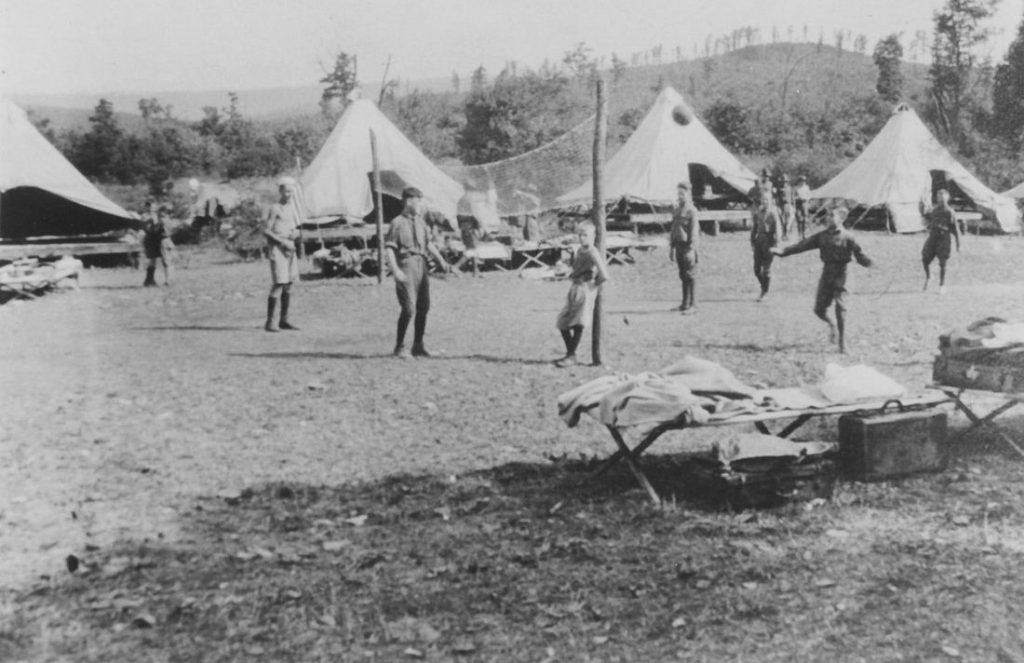
For some time the Council had sought to find a suitable spot for the Scouts of the Council to use as a camping area. The first camp was located at Icedale, north of Downingtown on the Horseshoe Pike. The camp proper was located in a meadow about 300 yards by 100 yards. On both sides the camp was surrounded by woods, while in back were the Welsh Mountains, and in front was the historic Brandywine Creek. The only permanent building was a Dining Hall and Storehouse. Pyramidal tents with no floors were the shelters used by the Scouts. Later, board platforms were added. The facilities were inadequate, for the swimming area was a half mile from the camp and the maximum depth of the water was four feet. Each Scout ate out of a tin pie plate or mess kit and after each meal there was a mad rush from the stream, for it was the responsibility of each Scout to keep his own eating utensils clean! This camp, Camp Lafayette, was used during the camping seasons of 1919 and 1920.

In the Spring of 1921, after much searching on the part of the Scout Executive, Mr. Henry Slutyer, and the Chairman of the Camping Committee, Dr. Joseph Rothrock, it was decided to mover the camp to a tract of State land near Pine Grove Furnace in the South Mountains. Work was started immediately to tear down the Dining Hall and tent platforms at Camp Lafayette and move by truck to the new site approximately 100 miles away. This site was located on a beautiful lake and was known as Camp Rothrock. In spite of the fact that this spot was much better suited for camping than was Lafayette, there involved the problem of transportation. This was solved to a degree when the Army provided trucks free of charge for the use of the Scouts going to Camp. The trucks would leave on Sunday morning and arrive sometime on Sunday evening. The drivers would stay overnight after unloading the Scouts and return to Chester County on Monday morning with the homebound Scouts.
By 1926, it was apparent to many that it would soon be necessary to search for a new campsite. Many people had built cottages near the Camp and the seclusion required was no longer available. It seemed to both Scouts and Staff that the Camp was in the midst of a summer resort. The Executive at first met considerable opposition, but soon the Camping Committee and the Executive Board saw that Rothrock had reached its maximum possibilities.
The requirements for a new site were quite rigid: it must be isolated; it must be a large enough area to take care of the needs of a growing Council; and it must be accessible to all parts of the County. After looking over many pieces, each with many good points to recommend them, the Council, much to the delight of Mr. B. F. Reynolds, who had moved his home from the Horseshoe Farm into Toughkenamon Valley, decided upon the Horseshoe Farm.
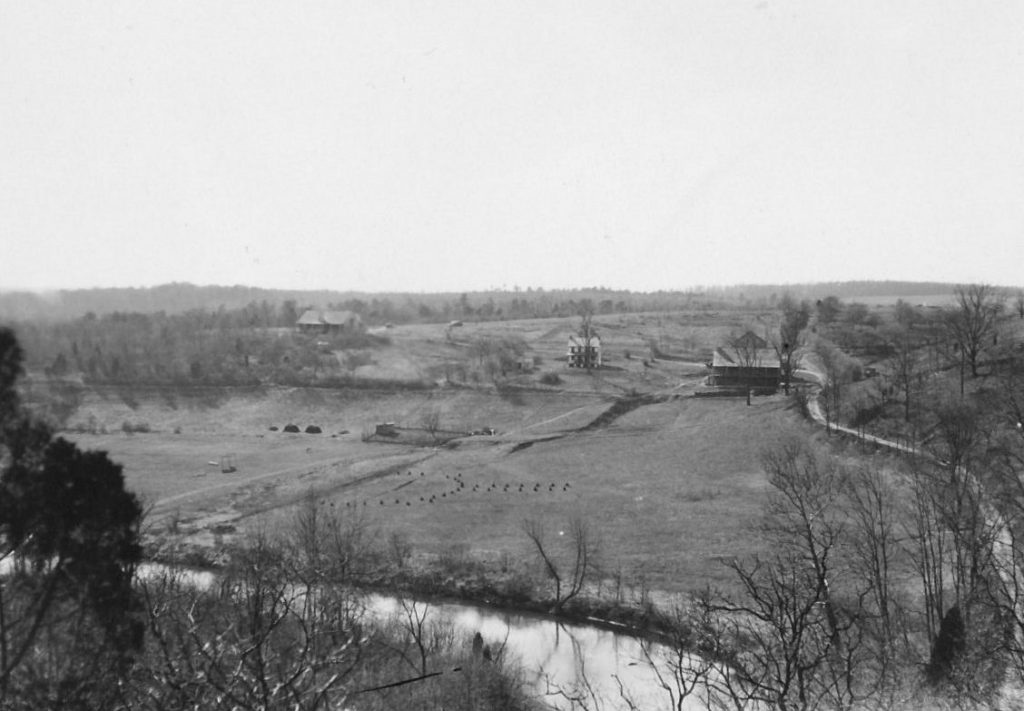
The deal was consummated in 1928 and work began in earnest under the direction of Robert Wolcott, President; J. Gibson McIlvaine, Treasurer; Gilbert McIlvaine, Architect; C. M. Heistand, Scout Executive; and many others.
Although the Reservation is located in the Southeast corner of the County and transportation is difficult for those living in the Northern end, this is no doubt the wisest choice that could have been made. Here was an area that had been little touched by civilization but had facilities for development. Here was an area only a few miles from the much-traveled U.S. Route 1, but yet it was in an almost isolated position. Here was an area that would answer the needs of the Council in 1928, and would answer the needs of the Council for many years in the future.
The architect, Mr. Gilbert McIlvaine, immediately set to design a camp. Work on the camp was begun in May, 1928, and the first season opened on July 19. The buildings already on the property were the first to be utilized. The old flint dwelling had long since become inadequate for the Reynolds family, and a larger home was constructed out of local field stone just up the hill and to the South of the original flint home. The exact date of the building of this new farmhouse is not definitely known.
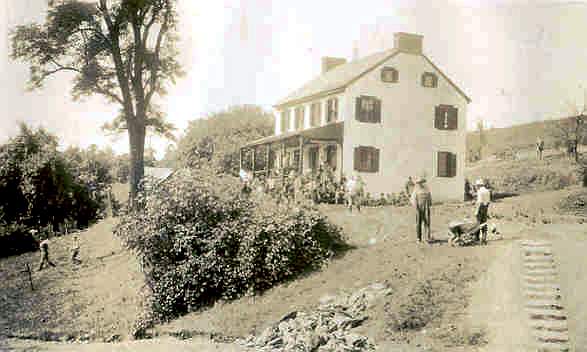
Upon the opening of the Camp, this building became the headquarters and was used as such for a number of years. The first floor of this building originally contained three rooms, each with its own fireplace. The second floor contained four rooms with no hallway to connect them. The attic contained one large room. In order to make the house more usable as a headquarters building, the two smaller rooms on the first floor were made into one room and one of the fireplaces was closed up. The second floor was provided with a washroom, and a hall was added. The third floor was divided into two storage rooms. For 18 years, the first floor was used as the Camp office and First Aid station, the second floor containing the Director’s office, Staff Quarters, and the Infirmary!
When the new Camp Headquarters was completed in 1947, the old Headquarters building was renovated with funds partly secured by the Mothers Auxiliaries of the County, and equipped for the use of mothers and other ladies who may be visiting the Reservation. The furniture for the first floor was secured and presented by the Mothers Auxiliary of District One. The renovated building with equipment and furniture was put into use in its complete form on Robert’s Day, July 24, 1948.

The Headquarters building was the original farm house on the old Reynolds farm of which the Camp is a part. The old spring house now known as the bug house, bears the date 1843.
The old barn on the property, which had been unused for many years, was destined to become an integral part of the Camp. The only useable part of the old structure was the foundation. Upon this was built “Kindness Center”, the center of all indoor activities. It was erected by the Pennsylvania Society for the Prevention of Cruelty to Animals. The members of this society believed the erection of such a building for the use of Scouts would impress upon the boys the Scout Law – “A Scout is Kind.” The building was described in the original Dedication Program of the Camp on July 28, 1928 as a,
“‘fine large building erected by the Pennsylvania Society for the Prevention of Cruelty to Animals, as a building for the use of the boys of Pennsylvania wherein they may study animals, birds, and living creatures and how best to extend kindness to them and how to prevent cruelty, all of which is part of the Scout program. A large hall with stage is provided, wherein officers and members may give lectures and show pictures teaching the objectives of the Society and for other purposes not inconsistent therewith. There are also two large stone fireplaces, a reading and writing room, a museum, a large basement room for Handicraft, and a fine large porch. The whole is certainly in keeping with the Society’s broad teaching that ‘Kindness is more powerful than compulsion.’“
All of the newly constructed buildings on the property were of Cypress, a wood that was plentiful and relatively inexpensive at the time of building. The selection of this wood for building is but another example of the foresight and straight thinking of the Council leaders, for this is one of the few types of wood in the world that is not affected by water, and will not rot, requiring no paint or wood preservative.

The first winter lodge was built in 1935-36, for the most part from lumber taken from the Paper Mill Superintendent’s House which was dismantled by the Camp Staff members and others in the latter part of the 1935 camping season. The building was dedicated in 1940 as a memorial to Gilbert McIlvaine.
The foundation and broad beams of the old wagon shed became the basic materials for the building of a winter lodge building. This contained a large fireplace and sleeping accommodations for any troop desiring to camp in the winter. Originally named “Scoutmaster’s Lodge”, this building was erected through funds given by citizens of the Main Line as a memorial to Edward Browning, the first Scoutmaster of Troop #50 of Devon. Several years after its construction the official name was changed from “Scoutmaster’s Lodge” to “Browning Memorial”, the name by which it is known today. In order to take care of the needs of winter campers, several changes have been made in the buildings to provide better facilities.

Also built at this time was perhaps in many ways the most important building on the property – the dining hall. Originally being laid out as a “T”, the building was designed for maximum ventilation and light. In 1958, the building was enlarged so that the capacity was doubled. Many improvements were also made in the kitchen. The Dining Hall is large and roomy with a large fireplace and a high peaked roof. This building was erected through the generosity of the Manufacturer’s Casualty Insurance Company of Philadelphia during the presidency of James K. Allen, hence its official name, “Allen Memorial”.
In the Spring of 1936 “Allen Memorial” was almost burned to the ground. A farmer across the creek had started a brush fire and, thinking that all was under control, went home to lunch. However, a stiff breeze arose and carried the fire down to the Octoraro and swept across onto Horseshoe property. The fire destroyed Taylor, Crocket and Carson, leaving only Boonesboro and Sherwood standing. The wind carried the fire to Flagpole Hill where much damage was done, and even today in many places the bark is still scarred as result of the blaze. Several sparks landed on the roof of the Dining Hall, and a large hole was burned in it. Even today, some of the charred timbers can still be seen in the old section.
The first stove in the kitchen was operated on wood and a good strong wind. On calm days it was doubtful if the meal would be on time, or if it was, it was seldom hot. Later, the stove was adapted to use coal. Many will remember the old coal shed in back of the building next to the shower, where, after they took a shower, their feet were blacker than they were before they went in! This, however, all changed when bottled gas was used and the water was heated automatically.
Five camps were erected to accommodate the Scouts coming to Camp. Each campsite was designed to hold 32 boys and 2 leaders. These sites too were constructed of Cypress and were in keeping with the general design of the larger buildings on the property.
The camp program was centered in these individual campsites, as can be seen from this descriptive literature for the camp in 1928.

Each Camp has its own special program of activities, its own name and is entered by a separate trail, as follows: Camp Unami, the Indian Lore camp, reached by the “Unami Path”. Camp Daniel Boone, the Pioneering and Nature Lore camp, reached by the “Wilderness Trail”. Camp Kit Carson, a beginners’ camp, reached by the “Santa Fe Trail”. Camp Dave Crockett, another beginners’ camp, reached by the “Alamo Trail”. Old Ironsides, the Sea Scouts and Water Activities camp, reached by the “Clipper Wake”.
Several of these names will sound familiar to Horseshoe Scouts and Scouters today while others are foreign. Camp Unami is today’s Sherwood Forest, Camp Daniel Boone is now Boonesboro, and Old Ironsides is known today as Bayard Taylor.
Sherwood Forest was named for the woods in which Robin Hood and his men had their rendezvous. The trail leading to the Camp is known as Sherwood Path.
Kit Carson, the noted pioneer and Indian scout furnished the name for this camp. The trail is called the “Santa Fe Trail”.
Davy Crockett honors the famous backwoodsman and hero of the Alamo. The trail leading to the camp is called the “Alamo Trail”.
Old Ironsides (1928) changed to Camp Mason-Dixon in 1929, to the Pirates in 1930, and later to Bayard Taylor in honor of the great Chester County writer.
In July of 1930, a group of Scouts camping in Boonesboro set out to find a site for overnight camping. They came upon a site not 200 yards from the main camp road, just above a spot where a small stream crosses under the road. This spot was named by them “The Pioneer Haven”, and after much work in clearing off the remains of four stills, tents were erected and a temporary building was placed over the small spring. In 1933, under the direction of Cecil Good, former Scoutmaster of Troop #70, of Thorndale and Assistant Executive, another camp was constructed on the site of the “The Pioneer Haven”. This Camp was named “Camp Thomas” after Uncle Ben Thomas who was formerly the Scoutmaster of Malvern #7 and Assistant Executive of Chester County Council. The purpose of this camp was to provide a base of operations for the older campers of that day. The group would hike to the Dining Hall for breakfast and dinner, their lunch being prepared at their own campsite. After being used only a few years, Camp Thomas was abandoned. All that now remains is an overgrown gateway and plaque on which the word “Camp” is inscribed. The gateway and plaque can be seen to the right of the entrance of the entrance road just before crossing the last bridge on the dirt road.
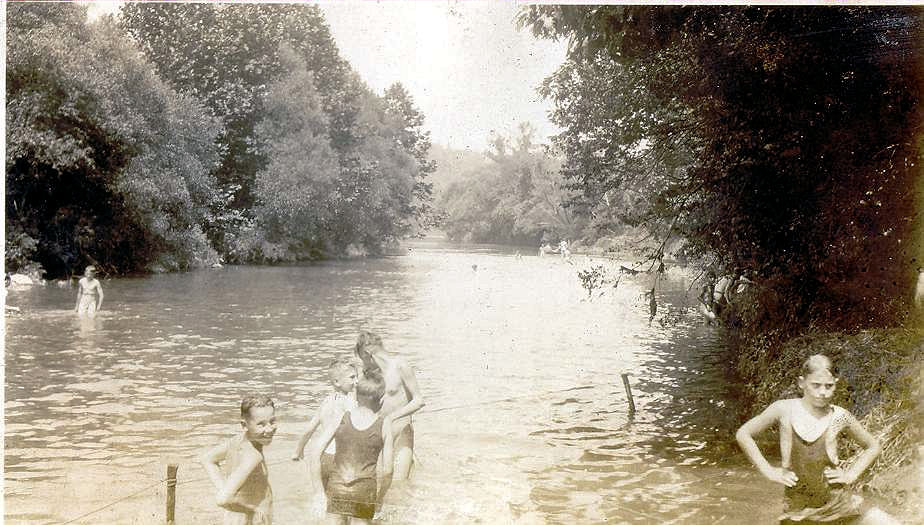
For two years, from 1928 to 1930, the Scouts attending camp used the waters of the Octoraro for swimming, but in 1930 another memorial to the foresight and excellent planning of the Council leaders was constructed – a swimming pool. This was no ordinary pool, being 150 feet long and 35 feet wide, going from a depth of 3 feet to a maximum depth of 10 feet. The original cost in 1930 was $22,700, a large sum for depression days. To replace this pool would cost from three to four times that amount. The water for the pool was pumped from the Octoraro, and after being filtered and chemically treated, is used for swimmers. Who of the many Scouts and Scouters using this pool can ever forget it: Crystal clear water surrounded by stately green trees provides a perfect setting for the beginner learning to swim, the advanced swimmer taking Swimming Merit Badge, and the older Scout learning Life Saving.
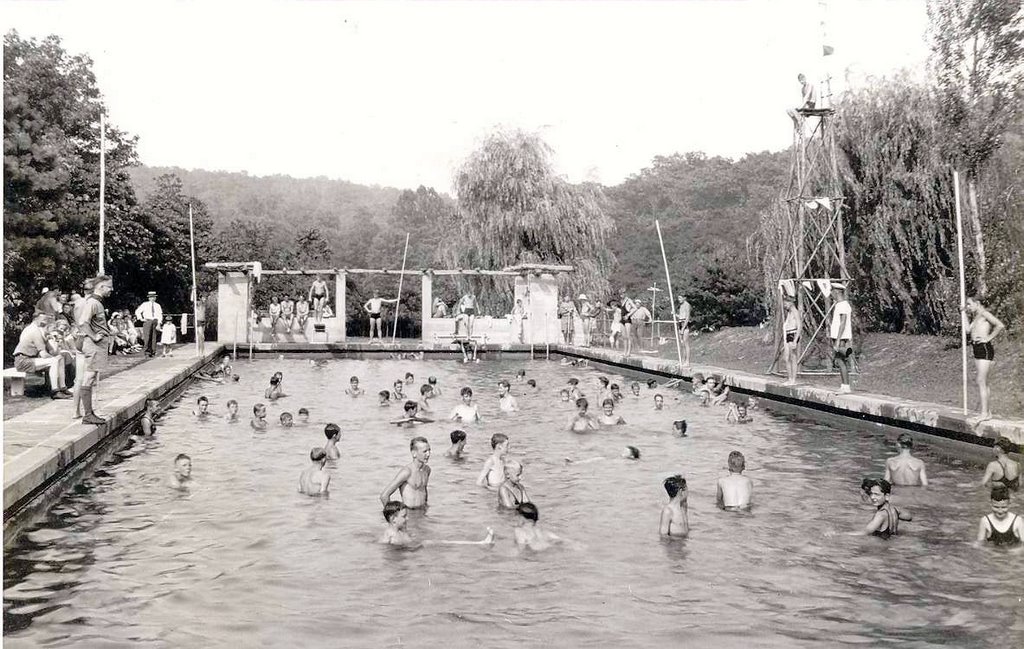
For the creation of the most beautiful swimming pool in Chester County, the boys are indebted to the citizens and friends of our County, who, through their generosity in the financial drive in 1928, made this pool possible.
The flood of the fall of 1931, covered the pool, flooded the filter room, damaged the pump, flooded the playing field, carried away the small bridge leading to pool across playing field. Similar damage occurred when the Octoraro flooded the area in August 1942 and June 1972.
Because of the increased number of Scouts attending camp, three additional campsites were added in the early 1950’s. Two of these camps, Camp Dan Beard and Camp Natureheart, were tent camps, the third, Camp Timberline, being a camp with Adirondack shelters. Previous to being used as a tent camp, Natureheart served as staff quarters until 1952, and in 1958 became the headquarters for the Conservation Department.
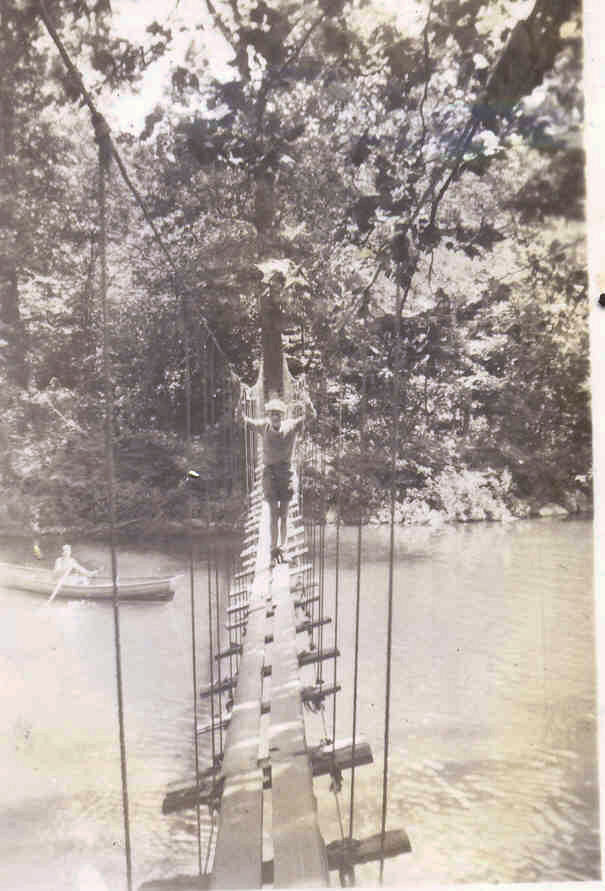
Another landmark in Camp, built in the early years, is the Swinging Bridge. The swinging bridge was first taken out by flood in 1931, again in 1932, in 1933 some trees were taken out along with the bridge, and again in 1935. The bridge was damaged in June and August 1942 by floods. In 1968 the O. A. constructed a suspension bridge to replace the old swinging bridge. This new span was dedicated to Louis Lester a Chief of Octoraro Lodge #22 and a past Council Executive.
Following the flood of 1972 the bridge again had to be rebuilt.
It is interesting how almost the same section of ground can be used for two so vastly different purposes. The Grey Horse Church, or as it was officially named, the Octoraro Methodist Episcopal Church, was built in the early 18th century to provide a place of worship for the nearby farmers. An interesting fact about this building is that the pulpit was in Chester County and the remainder of the church was in Cecil County, Maryland, the Mason-Dixon line passing through the very Church itself. The Church received its familiar but unofficial name, “Grey Horse Church” for an old grey horse that was used to bring the wood and materials for the building from the mill in back of the Green property. When the Council acquired the property around the church, services had not been held there for almost fifty years. An attempt was made to purchase the property and building, but the price asked was too high. The Council did board up the building to prevent tramps and vandals from using it, but this attempt was to no avail. All that is left of the Church is a portion of the foundation. At one time it was quite popular to hike up to the site of the Church and bring back a key from the old pump organ that was in the Church, just to prove that you had hiked all the way up the hill.
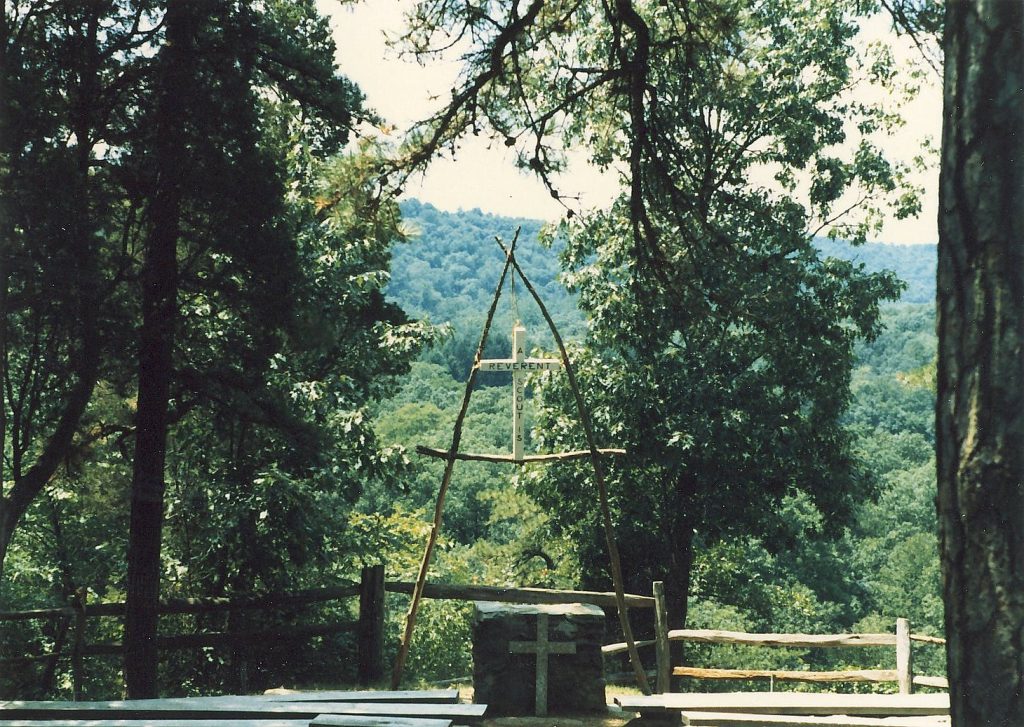
Although the Grey Horse Church is nothing but a memory and a group of crumbling ruins, there still remains on the property a center devoted to the spiritual training of those coming to Horseshoe – the Chapel. Situated on the hill overlooking the road, it commands perhaps the best view on the entire Reservation. From the Chapel can be seen the White House, the Athletic Field, Eagle Grove and Scouters Grove, and other outstanding buildings. The site was selected by the Order of the Arrow in 1929 and none can ever object to their choice. Using field stone for the pews and the pulpit, the sky above and the trees all around provide a setting to put many elaborate man-made cathedrals to shame. One can’t but be inspired by just sitting and looking out over the Almighty’s handiwork. The Sunday School and Chapel Service have become a Horseshoe tradition, and what Scout or Scouter can help but go away a better person after attending the service on a bright Sunday morning. The words, “Fair are the meadows, fairer still the woodlands and all the twinkling starry host” take on a new and different meaning when sung in God’s great outdoors.
The Chapel was made possible through the work of the Order of the Arrow, an organization important in the history of Horseshoe. The Order of the Arrow is dedicated to promoting camping and all that it stands for. Based on Indian custom and legend, it was organized in 1915, and quickly became an integral part of many Scout Camps. Our local Lodge, Octoraro #22, was the 22nd lodge organized in the nation and was quite active in the formation of many of the facilities at Horseshoe.

These buildings and the pool were the first projects undertaken in the formation of the new camp. However, when a visitor enters the camp today, the first thing that impresses him is not the buildings, but rather the beautiful green foliate that can be seen on all sides This sight is even more impressive if it is remembered that a large part of the land within the Horseshoe Loop was once used for farming. All of the evergreen trees and many of the hardwoods were planted by members of the Order of the Arrow and Scouts and Scouters camping at Horseshoe. Under the direction of the first Camp Ranger, Mr. Charles Cole, these trees were panted on the hills that once grew corn, wheat, rye and on the steep slopes that provided a barrier to the horse and plow, but provided an excellent area for erosion.
This tree planting was only one of the many ways in which Coley could show his love for the Camp and for the Scouts of Chester County. Coley originally came from Canada and settled in the area of Rising Sun when the dam at Conowingo was being built. He was hired by the Council to assist in the construction of the new buildings on the camp property and then was retained as the first full time caretaker. To many men who once camped at Horseshoe, Scouting, Camping, Horseshoe and Coley are synonymous. Few men in Chester County have done more for Scouting in the formation of young lives as has Coley. He was always on hand at a campfire to tell a story, to play his harmonica or to teach a new song. Few could forget those nights around the campfire with the wood crackling and the flames leaping skyward, and the very woods seem to be listening to the tales Coley was telling. For many years Coley served faithfully as Camp Ranger, repairing the buildings, carrying supplies from Rising Sun, being host to the hundreds of Scouts who camped at Horseshoe in the Winter, and keeping watch over the hundreds of acres entrusted to his care.
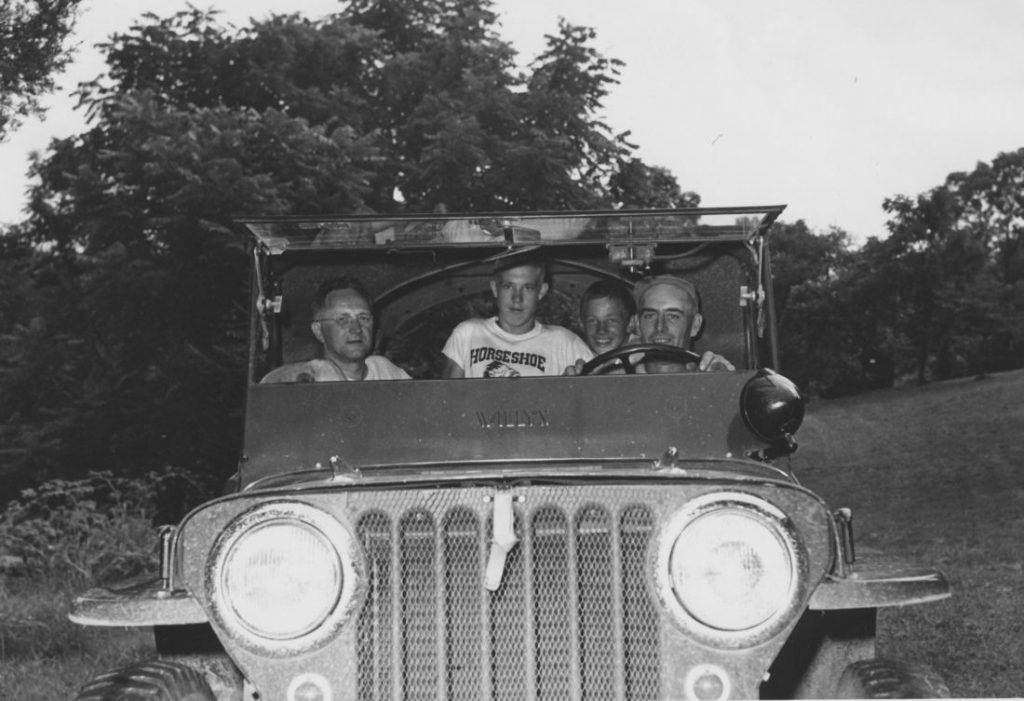
Today the position of Camp Ranger is filled by another member of the Cole family, George, Coley’s son. Carrying on the tradition of faithfulness and a sincere concern for Scouting, George has endeared himself to the hearts of present-day campers at Horseshoe.
The Camp Ranger’s home which is on Camp property and is owned by the Council, has been occupied by Coley and his sone George. This house is known as the Taylor House., for many years ago it was owned by three bachelor brothers by the name of Taylor. One of these brothers disappeared many years ago in a very mysterious fashion, and it was common gossip in the neighborhood that he was killed by the other two and buried back of the pump. His ghost is supposed to have reappeared regularly; in fact, a man named Bob Hedge fired at the ghost and the bullet holes are still visible just outside on of the windows. Hedge moved away and the following year seven families moved in and out, not being able to stay because they said the house was haunted. When C. C. Cole moved, the ghost is said to have moved out!
It was the last week of camp for the Scouts of Chester County Council and the Scouts from the Delmarva Council were to enter Horseshoe, the next week. It began to rain during the latter part of the week, and rain it did. The Octoraro began to rise, first making it necessary to check the boats tied to the dock. It was soon apparent that this was no usual storm, for the water had already begun to rise to the Athletic Field. Before the storm was over, the pool had been flooded, and the water had reached to the top of the benches at the pool. The water almost reached the swinging bridge, a good fifteen feet above the stream. By carrying many pieces of debris, logs and even bodies of pigs and cattle, the water cascaded down its enlarged bed, tore the swinging bridge loose from its moorings and took it on down, never to be seen again. At the entrance of the camp today the high water mark is clearly visible on the right of the hard road. This threat of high water is practically non-existent today, for a dam has been put in the Octoraro, which supplies the water for the city of Chester. This dam prevents extremely high water, which in turn takes a serious hazard from the camp.
The dam, however, did not prevent another flood in June of 1972. It had been raining for several days because of Hurricane Agnes; on Wednesday of Staff Week the Octoraro started to rise. By Thursday morning it was close to the top of its banks.. During the day the water continued to flow, necessitating several moves of the Boat Dock equipment, which was finally placed in the clearing below Kindness Center. In the early afternoon the rapid rise of the water required the removal of the Pool equipment and the removal of tents in Shawana. Because of the depth and speed of the water, several of the tents had to be abandoned and staff members watched as tent platforms were lifted and carried away. Another great lose was the four year old Louis Lester Memorial Bridge. Separated from dry land by two hundred yards of raging water, it was carried away while staff members stood by, unable to save it.
In the early evening, Mr. G. Ernest Heegard, the Camp Director, hiked into the camp by way of Grey Horse Church, over Flag Pole Hill, the only connection between Horseshoe and the outside world. Ernie arrived to find a camp without electricity, telephone or water.
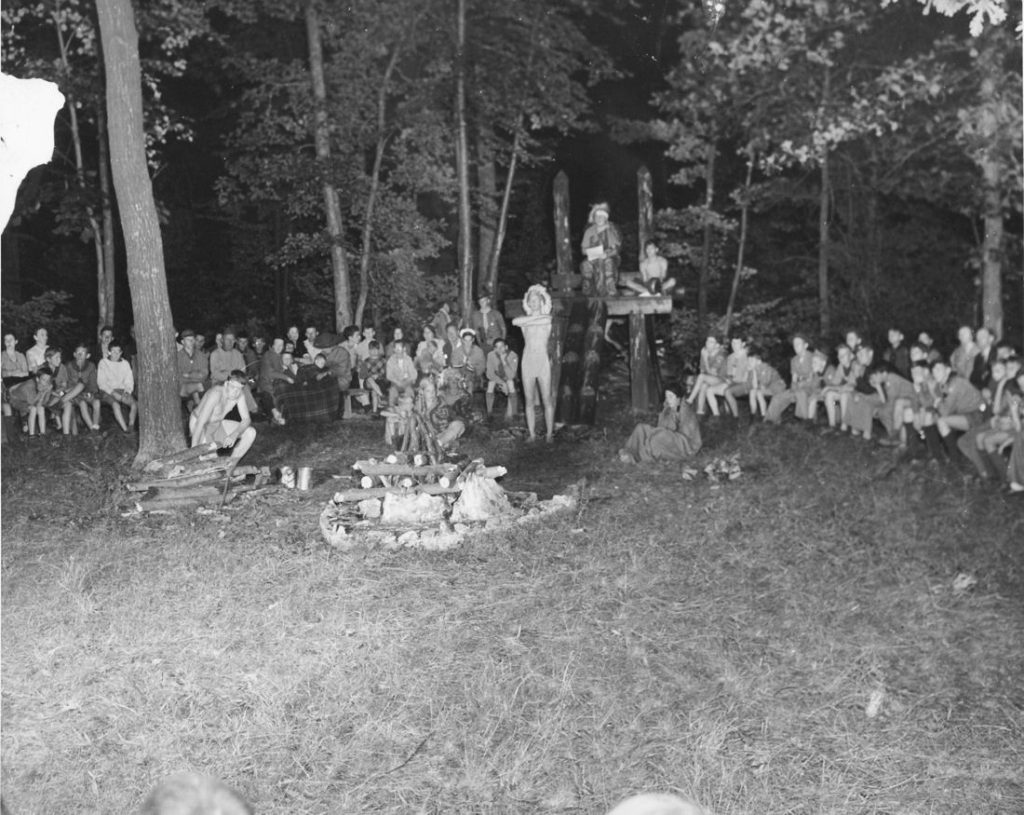
On Friday morning the staff awoke to find that the Octoraro had returned to its bed, but the damage the flood had left did not vanish so quickly. The boat docks had been completely destroyed, the archery range no longer existed; Shawana campsite had lost several tents and platforms, the pool was filled with mud and three feet long carp, and the new camp road, aid only forty-eight hours before, had holes in it big enough to hold a pick-up truck. Work was begun immediately to make the road passable. On Saturday morning members of the Order of the Arrow and trucks and drivers supplied by the mushroom growers of Chester County arrived to rebuild the road in preparation for camp opening the following day.
Camp did open on schedule although swimming and boating activities were severely curtailed. Crews working twenty-four hours a day did get the pool ready for use by the end of the first week of camp, making the Scouts camping that week very happy.
It seems to many that the Indians have never entirely left the Horseshoe loop, but linger still if in spirit only. The Saturday night Indian pageants presented by the Order of the Arrow keep fresh in our minds the contribution to American life and to Scouting of these early Americans. As the pageants unfold, a feeling of kinship with the past is experienced and one feels that the words of the Chief are true, “The Spirit of the Horse’s Hoof is today the Spirit of the Horseshoe” and often of a summer evening he returns to this sacred spot, where we stand, and gives his blessing to all who hear him – and when he talks he speaks in this wise. In the voice of the birds, of the rain, and in the gentle rustle of the trees; the Spirit of the Horseshoe is ever about us. Let us all be worthy of his presence.

Historical Account PDFs
Display Details
These documents provide some historical perspective of the reservation from various vantage points in time.
This PDF version of HORSESHOE is intended for 2-sided printing to recreate the original published pamphlet.
1973 – Contributed by Robert K. McCarter
This version of the Octoraro Lodge #22 HORSESHOE is a single-sided PDF of the original publication.
1973 – Contributed by Robert K. McCarter
This account is part of a collection compiled by Louis Lester and published in 1944. This is the only piece that does not credit an author but it was later discovered it was written by Edwin L. McKinstry.
1944 – Contributed by J. Roland Minshall
This excerpt from Wilmer MacElree’s book, Around the Boundaries of Chester County, documents some of the history of the land lying inside the bend of the Octoraro, now known as Camp Horseshoe.
1934 – Contributed by J. Roland Minshall
Historical Videos
Display Details
Here are historical videos of Horseshoe Scout Reservation from many years past.
A snapshot of life at Camp Horseshoe in 1943. Special Thanks to the 4 McCabe brothers – Eugene, Tom, Leonard, and Marty – for being contributors of this film and others over the years.
1943 – Contributed by Tom McCabe
A snapshot of life at Camp Horseshoe in 1944.
Special Thanks to the 4 McCabe brothers – Eugene, Tom, Leonard, and Marty – for being contributors of this film and others over the years.
1944 – Contributed by Tom McCabe
A snapshot of life at Camp Horseshoe in 1944.
Special Thanks to the 4 McCabe brothers – Eugene, Tom, Leonard, and Marty – for being contributors of this film and others over the years.
1944 – Contributed by Tom McCabe
A snapshot of life at Camp Horseshoe in 1945.
Special Thanks to the 4 McCabe brothers – Eugene, Tom, Leonard, and Marty – for being contributors of this film and others over the years.
1945 – Contributed by Tom McCabe
Here is a history tour of HSR produced by Chester County Council in 2020.
2020 – Contributed by Anonymous
Tour Stops
History Tour 1
Potpourri Tour
Follow us on social media

© Horseshoe Scout Reservation Alumni Association 2025