

Exhibit Details
The five original campsites at the time of Horseshoe’s opening in 1928 were stockade sites. They were today’s Sherwood Forest, Boonesboro, Kit Carson, Davy Crockett and Bayard Taylor. A sixth stockade site, Clifton Lisle, has since been added.


Sherwood Forest Campsite
Display Details
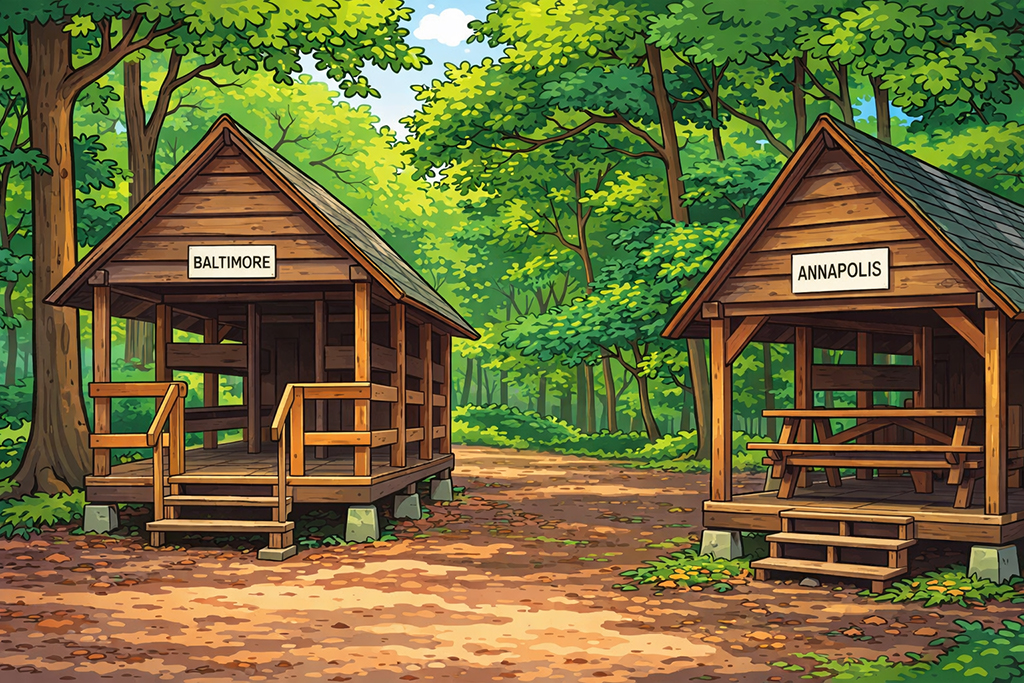
When Camp Horseshoe opened in 1928, today’s Sherwood Forest campsite was known as Camp Unami, the Indian Lore camp.


Boonesboro Campsite
Display Details
Boonesboro was originally named Camp Daniel Boone and was the site of the Pioneering and Nature camp. The name “Boonesboro” comes from Boonesborough, Kentucky, founded in 1778 by Daniel Boone as one of the first English-speaking settlements West of the Appalachian mountains.
Kit Carson Campsite
Display Details
Camp Kit Carson was one of the Beginner camps for new Scouts when Horseshoe first opened. It changed to a troop site when the camp program shifted to camping with your home troop and leaders.
Davy Crockett Campsite
Display Details
In the early days when Scouts did not come to camp with their home troop, Camp Davy Crockett was one of the Beginner camps for new Scouts. The site is named after Davy Crockett, the frontiersman who died at the Battle of Alamo on March 6, 1836.
Bayard Taylor Campsite
Display Details
Bayard Taylor campsite is named for the Chester County writer. During the first three years of Horseshoe, this site went through three names, Old Ironsides, Camp Mason-Dixon and Pirates.
Col. Clifton Lisle Campsite
Display Details
The construction of the Lisle campsite began in 1985-1986. Col. Clifton Lisle’s widow contributed some money and Camp Horseshoe abandoned the old Shawana site by the pool and literally moved the Adirondack shelter up where Lisle is today. It began as a platform tent site, but over time the camp converted it to a stockade site. The Smith Foundation funded the construction, and Dick Bensing designed it and oversaw the construction.
Videos
Display Details
Here are a few videos of life in the Camp Horseshoe Stockade sites.
A quick look around Sherwood Forest campsite.
2002 – Contributed by Alexander Musto
During a hard cover storm, Scouts have some fun while not violating the hard cover of the Sherwood stockades.
2014 – Contributed by Jeffrey L. Goodman
The Bayard Taylor campsite in 1943.
1943 – Contributed by Tom McCabe
Clifton Lisle Tour
Here is a quick tour of the Col. Clifton Lisle campsite in Winter.
2019 – Contributed by Ann B. Perrone
Boonesboro Tour
Here is a quick tour of the Boonesboro campsite in Winter.
2019 – Contributed by Ann B. Perrone
Narratives
Display Details
Here are some stories that provide more information about life in Camp Horseshoe’s stockade sites.
2001 – Contributed by John B. Rettew III
This article by J. B. Rettew gives a brief history of the original Camp Horseshoe stockade sites. It first appeared in the July 2001 issue of the The Octoraro Loop.
Editor’s Notes June 2001
I was walking out of Allen Memorial Dining Hall with Moose Winsch after taking pictures for this issue of The Loop. We were discussing some of the articles in the Loop he liked and he brought up the question as to whether campers today knew any of the history behind the naming of the original five Stockade camps. He thought this might be of interest to some of our younger alumni/ae.

Ernie Heegard’s column mentions the five Stockades. He was in Kit Carson Stockade his first year. I was in Boonesboro in my first year, 1944.
There were five Stockade camps built in 1927-28 for campers that first summer and used ever since then. A visitor to Horseshoe in 1933 wrote of the camps in his treatise, referring to them as “Kit Carson, Boonesboro, Fire Circle, Sherwood Forest and Bayard Taylor”.
Another historian in his writings refers to “Camp Unami, Camp Daniel Boone, Camp Kit Carson, Camp Dave Crockett; and, Old Ironsides Camp (the Sea Scout and Water activities Camp).” Later, the Unami Camp was re-named Sherwood Forest; Daniel Boone became Boonesboro; Old Ironsides became Camp Mason-Dixon (it straddles the Mason-Dixon Line) in 1929 and Pirates camp in 1930. Subsequently, it was renamed Bayard Taylor in honor of the great Chester County writer.
The stockades form a crescent. In earlier days of camp, trails (now the stockade trail) leading to each camp carried a specific name related to the history of the specific camp. Kit Carson was reached by the “Santa Fe” trail; S h e rwood Forest (then Unami) was reached by the “Unami Pa t h ” ; Boonesboro by the “Wilderness Trail”; Dave Crockett was reached by the “Alamo Trail”; and, Old Ironsides by the “Clipper Wake” trail.
In future issues, I hope to shed more light on the other camp units that today make up both Camp Horseshoe and Camp John H. Ware, 3rd. Also, I’ll try to publish the text to the songs that each camp sang after the meal in Allen Memorial in those years from 1928 to the ’50’s.
2006 – Contributed by G. Ernest Heegard
This article by Ernie Heegard appeared in the July 2006 issue of the HSRAA Octoraro Loop.
One evening while at camp, Moose (alias Karl Winsch) and I were sitting at camp and came up with a number of things that are no longer found at camp. One of these items was very important during the 1930’s, and1940’s. It was not until well after WW II that a suitable inflatable air mattress was developed.
Some Scouts and leaders have wondered why the bunks in our stockade buildings are built more like coffins than a standard bunk. Some have speculated that the high sides were designed to prevent Scouts from rolling out at night. This is partially true. The real reason is that the early Scouts were required to bring a cot-sized mattress cover or sew up a large bag out of light canvass ticking. Some finished them with a zipper at one end. Most Scouts came with a supply of large safety pins. After the Scouts checked in and reported to their stockade (Sherwood Forest, Boonsboro, Kit Carson, Davey Crocket, and Bayard Taylor), they were directed by their stockade leader to go to the “straw hut”, which was located to the rear of what is now the old Quonset hut on the Loop Road. This was manned each Sunday by a camp staff member to prevent Scouts from overfilling their “straw tick”, which was the name for this type of mattress.
Those Scouts, who overfilled the tick, did in fact roll off the bunk at nighttime. Those with too little straw found that ‘bed and board’ is the same thing at Horseshoe. After church service on Sundays, those Scouts leaving camp would drag their straw tick back to the straw hut and empty it there to be used again. However, there seemed to be at least one Scout each Sunday, who dragged his tick to the straw hut by the wrong end, and left a trail of straw along the way. Naturally, he was required to retrace his steps with a rake and clean up the mess he had left.
The straw hut had another exciting feature. Scouts later in the afternoon would be digging further back in the straw and would often uncover a sleeping black snake, which invariably would be caught and put on display at the Bug House Nature Center, which was to the right of the old Headquarters/White House.
Once the air mattress, developed during WW II, started showing up at Army Surplus stores, the straw tick became less and less used. Finally the straw hut was torn down –
GONE BUT NOT FORGOTTEN!
PS – Think of what it must have been like in the straw hut on a hot, steamy and sweaty Horseshoe day with all the straw flying around in the air! No wonder we all wanted to take the swim test that day!
2007 – Contributed by G. Ernest Heegard
The following article by Ernie Heegard was originally published in the ‘Ernie Says’ column of the Summer 2007 issue of the Octoraro Loop.
In More than sixty years have passed, but the memories of my first week at Horseshoe for summer camp are just as vivid today as they were that first summer in my Stockade campsite.
After arriving at Horseshoe, I dashed off to the front porch of the White House to check in, then out the back door to join some other Scouts bound for the Kit Carson Stockade, our camp-site for the next 2 weeks. Each camp-site (or stockade as they were called in the early years,) was named for a key person or place in history. The names and buildings have not changed over the years, and have been wonderfully maintained by the Order of the Arrow.
The five original sites were constructed of cypress wood, consisting of a leaders’ cabin flanked by four bunk houses – each with only a back wall and 2 canvas roll-down sides. Sherwood Forest was on top of the hill and named for Robin Hood’s hide-out. Then proceeding down (or south) along the stockade trail (the upper part of this trail is paved and part of the loop road), you encounter the Boonesboro Stockade named for Daniel Boone. Further on the trail, is the third stockade, Kit Carson, named for a western pioneer. The remaining two camp-sites are: Davie Crockett, named for a famous woodsman; and Bayard Taylor, a Chester County legend.
The Taylor stockade straddles the Mason-Dixon Line, separating Maryland and Pennsylvania. This dividing line actually passes through the middle of the leaders’ cabin, leaving half of the group sleeping in Maryland, and the other half sleeping in Pennsylvania.
Each stockade was staffed by a college student, with a strong Scouting background, and employed as a “provisional” troop leader for the summer. Scoutmasters rarely attended camp, but would drop by from time to time. Most Scouts came to camp as individuals, or with 3 or 4 from the same troop, depending on their choice of camping periods.
A Scout’s first Sunday at camp was jampacked with many things to be accomplished – preparing your bunk by filling a canvas sack with straw, hiking to the pool for a swim check, and orienting ourselves with a quick guided hike around the camp.
Upon returning to Carson we quickly donned our uniforms for inspection. The Scouts required a bit of adjusting by our leaders to form this diverse group of individuals from many different troops to look like a cohesive, functioning Scout troop. A few extra minutes were then spent learning the Kit Carson Stockade song: “Over hill, over dale, As we hit the dusty trail, To Kit Carson, the best camp of all!……..” and a couple of cheers for the ‘song and cheer challenge’ which awaited us following that evening’s meal.
We were then led to the parade field, which had to be cleared of any remaining cars, in order to allow each troop to practice marching. Each stockade leader stressed a good showing during the ceremony of ‘lowering the flag’. I’m sure we did not win retreat that night, but I do remember almost jumping out of my skin when the canon was fired!
After the opening camp-fire that evening at the Natureheart staff site, a small tenting area for the nature and kitchen staff, we returned to the Carson Stockade for clean-up and Vespers. All eight bunks were filled in our bunk house.
Prior to “Taps” being sounded, all the Scouts were seated on the porch-ends while our leader and his assistant gave an inspirational thought for the day. The camp chimes seemed to be perfectly timed to the final words of our leaders and were played from a small wooden tower located in what is now the campcraft area. While were climbing into our bunks, the camp bugler played Taps, which echoed around the hills of Horseshoe. Very exhausted, we all drifted off to sleep listening for the sounds of the whip-o-wills.
Not the next day, but a few days later, was the cooks’ day off. The kitchen was closed, but each patrol/bunkhouse had to send one Scout to the dining hall to pick up the food for breakfast. It had rained overnight, but was still intermittently showering. The side flaps on our bunkhouse were rolled down, protecting the bunks from the rain, and afforded us some cover for what we were about to do. Our instructions were to gather wood to build a fire in order to boil water for oatmeal and raisons, and then fry eggs and bacon, all to be done after the food arrived. Instead, we hastily employed the “democratic process” and took a vote! It was unanimous – no one wanted to venture forth for fire-wood, build a fire, or cook in the rain.
Clinton, a bunk-mate from Troop 50 or Berwyn 11, came to camp well equipped, and drew from his pack a small heat-tab stove, and so began the slow process of each of us frying our eggs and bacon in our own mess kits. We planned to skip the oatmeal. The bunkhouse porch afforded protection from the rain and the long tarp shielded us from view from the leaders’ cabin. No sooner had the cooking begun . . . . who should appear from out of nowhere, but the impressive figure, MR FRANK BEAM, the Camp Director!
He was in full uniform, raincoat and broadbrimmed campaign hat! The scene on the floor of the bunk house must have been incredible – 8 scruffy young Scouts, with mouths gaping, crouching around a tiny collapsible stove merely 5 inches by 5 inches emitting a little blue flame coming from a white pill, which looked like a slightly oversized Alka-Seltzer tablet. WELL!!!!!! Mr. Beam was not going to let this pass.
The next 45 minutes he gave a highly personalized course on dressing for the weather, collecting squaw wood (small dead wood hanging in the vines), fire-building, and cooking the entire intended breakfast, not to mention the finer techniques of clean-up. The totally embarrassed eight of us all had to agree at the camp director’s urging, “Wasn’t that a better and more Scouting way of doing breakfast?” Looking back, many important life’s lessons were learned that early rainy morning. Thus, the first of many, many lasting memories of stockade life.”
Early Stockade Life
Display Details
The first set of early photos were found amoungst the Council archives. Their exact history is unknown but the were likely to have been used as promotional material.
The last few photos were contributed by Jean Brown (via Bill Waxbom), widow of HSR Alum Donald C. Brown, district judge for Chester County.
Miscellaneous
Display Details
Here are some structural drawings of the stockades as well as images of the 2022 HSRAA historical marker created for the stockade sites.
Newspaper Articles
Display Details
Here you will find a few newspaper articles talking about the devastating fire of 1938 that destroyed several stockade sites.
From the Sunday May 9th, 1938 Daily Local News, this article chronicles the damage to Camp Horseshoe caused by a brush fire.
1938 – Contributed by John B. Rettew III
From the May 13, 1938 edition of The Midland Journal, this article discusses the wildfire that destroyed many stockade cabins on May 7 at Camp Horseshoe.
1938 – Contributed by Andrew Coe
From the May 20, 1938 edition of The Midland Journal, this article tells who the rebuilding contract was awarded to for the sixteen destroyed stockade cabins: Baughman and McCauley.
1938 – Contributed by Andrew Coe
Timeline
Display Details
Here is a timeline of the known milestones of stockade sites at Camp Horseshoe.

First Stockade Sites Built
To coincide with the opening of Camp Horseshoe, the first five stockade sites were built.

Stockade Cabins Burned Down
Three of the five stockade sites burned down when sparks from a brush fire on an adjoining hill caught the cabins and caused $6,000 in damage. The sites were quickly rebuilt for the opening of summer camp.

Lisle Becomes a Stockade Site
The Lisle campsite was converted to a stockade site in 1994, funded by Col. Lisle’s widow and the Smith foundation.

Sherwood Forest Gains a Cabin
In 2005, a fifth cabin was added to the Sherwood Forest campsite.
Boonesboro Pavilion Dedicated
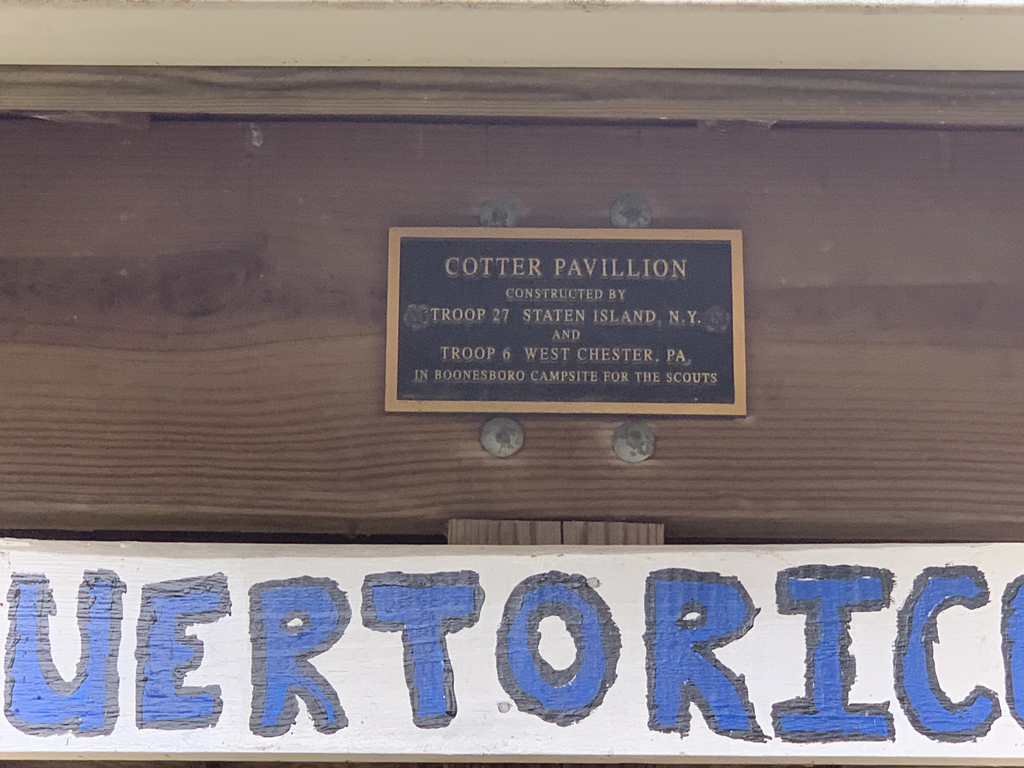
The “Puerto Rico” pavilion in Boonesboro Campsite at Camp Horseshoe was dedicated to Theodore Cotter, Scoutmaster of Troop 27, who passed away in 2009.

Kit Carson Pavilion Constructed
A new pavilion was constructed for the Kit Carson stockade site in 2017.
Sherwood Forest Pavilion Constructed
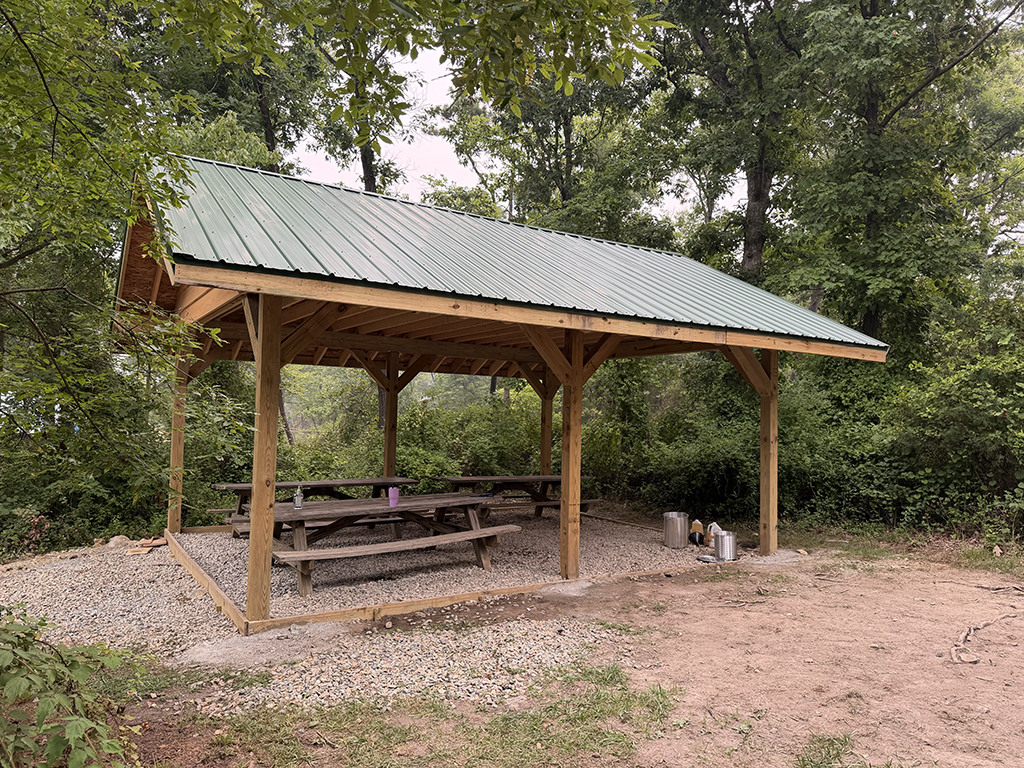
A pavilion was built in 2026 for the Sherwood Forest campsite.
Follow us on social media

© Horseshoe Scout Reservation Alumni Association 2025